

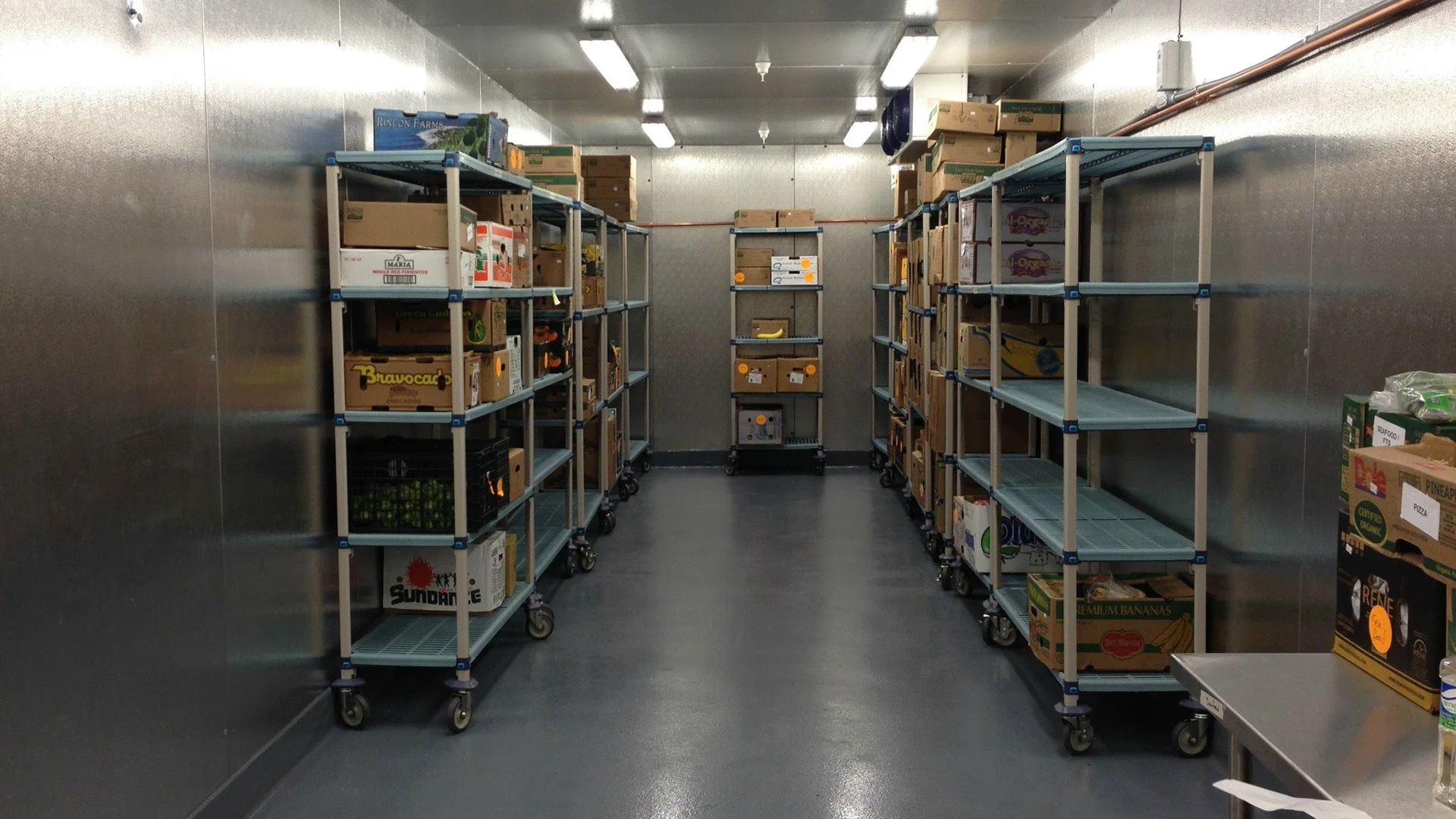
“It’s still working” is the most expensive phrase in commercial refrigeration. Equipment that’s running isn’t necessarily equipment that’s running efficiently — or holding food at a safe temperature.
Here’s where deferred maintenance actually costs you, using published figures rather than guesses.
Energy waste: around 17% on average, from coils alone
The clearest evidence on this comes from a San Francisco Department of the Environment study cited by ENERGY STAR. Researchers cleaned the condenser coils on ten commercial refrigeration units and measured the difference.
The results varied enormously depending on how dirty the coils were to begin with — a 2% reduction in energy use for units that were already fairly clean, up to 49% for one particularly grimy example. Across all ten units, the average reduction was 17%.
ENERGY STAR puts that in money using an average annual refrigeration cost of roughly $5,800 for a food-service facility: a 17% reduction is about $986 a year, from coil cleaning alone.
That is one maintenance task. Worn door gaskets, low refrigerant charge and failing fan motors each add their own load on top, because in every case the compressor is working harder to hold the same temperature.
Spoiled product: whatever is in the box
We won’t put a number on this one, because it depends entirely on what you were holding when the equipment failed. A walk-in that goes down overnight with a full weekend’s prep inside is a different loss from a reach-in that fails on a Tuesday afternoon.
What is predictable is the timing. Refrigeration tends to fail under load — during a rush, in summer heat, when the doors are cycling constantly — which is exactly when the box is fullest and when you can least afford to lose the menu.
Emergency repair costs more than scheduled repair
An after-hours emergency call carries costs a planned visit doesn’t: out-of-hours labour, rush parts sourcing, and dispatch disruption. Our own diagnostic fee is a flat $125 for most commercial cooling and cooking equipment and $250 for commercial ice machines, and emergency or after-hours charges may apply depending on the timing and urgency of the call. Any applicable fees are discussed and approved before we dispatch.
The saving isn’t really in the labour rate, though. It’s that a fault caught during a scheduled visit is usually still a small fault.
Health code: $250 to $1,000 per penalty — and then your licence
This is the part most operators get wrong, and it is worth being precise about.
Under the Colorado Food Protection Act (C.R.S. § 25-4-1611), a retail food establishment that was given written notice of a violation and a reasonable time to comply, and remains in noncompliance, is subject to a civil penalty of not less than $250 and not more than $1,000. A maximum of three civil penalties may be assessed in any twelve-month period.
So the fines themselves are not enormous. The real exposure is what happens next: when a third civil penalty is assessed within twelve months, the health agency may begin proceedings to suspend or revoke your licence. A failed inspection can also mean a temporary closure while you correct the problem.
Failed refrigeration is a direct route there, because an inspector is assessing the temperature of your food right now — not the reason your compressor stopped last night.
Shortened equipment life: 15–25 years becomes 8–12
A properly maintained walk-in cooler or freezer can often stay in service for 15 to 25 years or longer. Routine preventive maintenance — condenser cleaning, refrigerant system inspection, door and gasket maintenance — is what gets it there.
Neglected systems frequently suffer major failures much sooner, often within 8 to 12 years. Dirty coils, poor airflow, ignored refrigerant leaks, damaged doors, failed gaskets, moisture intrusion and deferred maintenance all shorten equipment life, and the compressor usually goes first because it has been compensating for all of it.
That’s the compounding cost. You pay in energy the whole time the equipment is struggling, then you pay again when it fails a decade earlier than it needed to.
The maths
A preventive maintenance program is priced against your equipment count, and we quote it after looking at what you actually run. Weigh that against the published 17% average energy penalty on dirty coils, the product you’d lose in a failure during service, and equipment reaching 8 to 12 years instead of 15 to 25.
Talk to us about a maintenance program that fits your operation.